
Play Tome of Madness Now!
Home → Demo
Tome of Madness Demo
What the Tome of Madness demo gives you
Tome of Madness by Play'n GO offers a high volatility slot experience with a theoretical RTP of 96.59%, which establishes a house edge of exactly 3.41% over extended play sessions. This specific return percentage contrasts sharply with the lower configurable tiers reported by some operators, such as the 94.52% or 91.2% variants that may appear in different casino environments. Players engaging with the standard version can expect variance consistent with the high volatility classification, meaning wins will be less frequent but potentially larger than in low volatility titles. The maximum win cap is set at 2000x your total stake, providing a clear upper limit for potential payouts during any single gaming session.
The game mechanics utilize a 5x5 reel layout with Cluster Pays, distinguishing it from traditional payline slots like Book of Dead, which uses a 5x3 setup and features distinct free spin triggers. This grid structure allows symbols to cascade after each winning cluster, creating opportunities for consecutive wins within a single spin cycle without requiring additional bets. The Lovecraftian theme permeates the visual design, offering a dense narrative backdrop that complements the mathematical model provided by Play'n GO. Unlike crash games, Tome of Madness operates entirely on random number generation with no cash-out button, ensuring outcomes remain purely chance-based.
Accessing the full feature set requires understanding that the Cascading/cluster grid mechanic replaces static reels, allowing new symbols to drop into empty spaces after wins are paid out. This dynamic interaction increases the hit frequency compared to static grid slots, though the high volatility ensures that long dry spells between significant wins are statistically probable. The title Rich Wilde and the Tome of Madness integrates these mechanics seamlessly, maintaining engagement through rapid reel resets rather than complex bonus rounds. Players should note that the 2000x max win applies to the base game and features combined, capping the total payout regardless of consecutive cascades achieved.
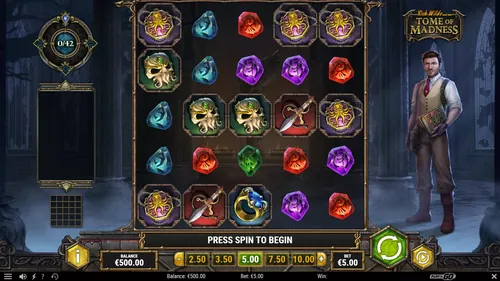
Starting the demo without registration
The demo version of Tome of Madness launches directly in the browser without requiring any account creation or personal data submission from the player. This immediate access allows users to test the 96.59% RTP configuration before deciding whether to deposit funds or explore other titles like Book of Dead. The absence of registration barriers means players can evaluate the high volatility nature of the game without financial commitment or identity verification steps. This frictionless entry point supports informed decision-making regarding the 3.41% house edge inherent in the standard Play'n GO release.
Operating the simulation involves utilizing virtual credits that reset automatically upon page reload or session termination, ensuring no real money transactions occur during testing. These demo balances mimic the bet sizes available in the real money version, ranging from minimum stakes up to maximum limits defined by the operator. The 5x5 grid displays clearly, allowing players to observe the Cluster Pays mechanism in action without pressure from time constraints or wagering requirements. This environment provides a safe space to understand the cascading symbol drops that define the core gameplay loop of Rich Wilde and the Tome of Madness.
Technical performance remains stable across devices due to HTML5 implementation, ensuring smooth animations for the Lovecraftian-themed symbols and effects. The lack of server-side validation for demo spins means results are generated locally or via lightweight API calls, reducing latency compared to live dealer interactions. Players can verify the 2000x max win potential by observing the paytable values, which scale proportionally with their chosen bet size. This transparency helps manage expectations regarding variance, as high volatility slots naturally exhibit wider swings in bankroll fluctuations during extended play periods.
Demo balance and bet sizes
Demo balances typically start at a fixed amount, often 1,000 or 10,000 credits, which serves as a proxy for real currency without actual monetary value attached. These virtual funds allow players to experiment with various bet sizes, understanding how stake levels impact the frequency of Cluster Pays wins on the 5x5 grid. Adjusting bets demonstrates the linear relationship between stake and potential payout, crucial for grasping the risk-reward ratio of high volatility slots. The 96.59% RTP remains constant regardless of bet size, meaning the theoretical return percentage does not change with wager adjustments.
Bet configurations in the demo mirror real money options, enabling players to test strategies within the constraints of the 2000x maximum win cap. Increasing the stake raises the absolute value of each win but does not alter the underlying probability distribution governed by Play'n GO's algorithms. Observing how quickly the demo balance depletes under high stakes highlights the aggressive nature of high volatility mathematics, where large losses can precede significant wins. This insight prepares players for the emotional and financial demands of switching to real money mode, where the 3.41% house edge becomes a tangible cost.
Resetting the demo balance is instantaneous upon refreshing the page, eliminating any need for manual credit replenishment or waiting periods. This feature allows unlimited testing of the Cascading/cluster grid mechanics without financial consequence, facilitating a thorough understanding of the Rich Wilde and the Tome of Madness systems. Players can compare these demo parameters against other titles like Book of Dead, noting differences in volatility profiles and max win potentials. Such comparisons aid in selecting appropriate games based on individual risk tolerance and preferred session lengths within the broader Play'n GO portfolio.
What carries over to real money
Game mechanics and visual themes transfer directly from demo to real money mode, preserving the 5x5 Cluster Pays structure and Lovecraftian aesthetic of Tome of Madness. The 96.59% RTP and 3.41% house edge remain mathematically identical, ensuring consistency in expected returns across both modes. However, the psychological impact of risking actual currency alters player behavior, often leading to more conservative betting strategies despite identical odds. Understanding this distinction is vital for managing expectations when transitioning from free play to real money sessions involving the 2000x max win potential.
Bonus features such as the Cascading reels function identically in both modes, triggering randomly after winning clusters and replacing symbols with new ones. The probability of hitting these features depends solely on the RNG algorithm, unaffected by previous outcomes or demo play history. Real money players must consider the 300% welcome bonus up to €2,000 plus 100 free spins offered by casinos, which can extend playtime significantly. These bonuses often come with wagering requirements that influence how effectively players can convert demo-tested strategies into profitable real money outcomes.
Statistical metrics like hit frequency and volatility remain unchanged, meaning the frequency and size of wins follow the same distribution patterns in real money play. Players who enjoyed the high variance of Tome of Madness in demo mode will experience similar swings, including long dry spells between substantial payouts. The transition requires careful bankroll management, as the 3.41% house edge compounds over time, eroding balances faster than in low volatility alternatives. Recognizing these constants helps maintain realistic goals and prevents chasing losses driven by unrealistic expectations formed during unrestricted demo sessions.
Browser requirements for the demo
Modern web browsers support the HTML5 technology powering Tome of Madness, ensuring compatibility with Chrome, Firefox, Safari, and Edge without additional plugins. The 5x5 grid renders efficiently on desktop and mobile devices, maintaining smooth animation speeds for the Cascading/cluster grid mechanics. Players should ensure their browser is updated to the latest version to avoid performance issues or display glitches during gameplay. This technical requirement guarantees consistent access to the 96.59% RTP configuration and high volatility features without hardware limitations interfering with the experience.
Internet connectivity stability affects load times but not the randomness of outcomes generated by Play'n GO's servers once the game initializes. A stable connection ensures seamless transitions between spins and rapid updates of the Lovecraftian-themed symbols during winning clusters. Mobile users benefit from responsive design adaptations, optimizing the interface for touch interactions while preserving the full functionality of Rich Wilde and the Tome of Madness. Testing connectivity beforehand prevents interruptions that could disrupt observation of the 2000x max win potential during critical moments.
JavaScript execution is essential for calculating Cluster Pays wins and triggering subsequent cascades, requiring browser settings to permit script execution for the domain. Disabling JavaScript will prevent the game from loading or functioning correctly, rendering the demo inaccessible for testing purposes. Users should also disable ad blockers that might interfere with asset loading, particularly for high-resolution graphics associated with the theme. Ensuring optimal browser configuration allows uninterrupted evaluation of the game's mechanics, supporting informed decisions about real money participation based on accurate performance data.
Tome of Madness: key facts
| Parameter | Value |
|---|---|
| Game | Tome of Madness |
| Studio | Play'n GO |
| RTP | 96.59% |
| House edge | 3.41% |
| Volatility | high |
| Max win | 2000x |
| Reels | 5x5 |
| Paylines / ways | Cluster Pays |
Reading the paytable in demo mode
The slot Tome of Madness by Play'n GO displays a 5x5 reel layout that utilizes Cluster Pays mechanics instead of traditional paylines. This configuration means symbols must form adjacent groups to trigger wins, directly linking the visual grid structure to the payout logic. Players analyzing the theoretical return should note the RTP sits at 96.59%, establishing a house edge of 3.41% over extended sessions. This percentage defines the long-term expected loss rate for every unit wagered on the cluster-based grid.
Operators sometimes distribute versions with an RTP of 94.52%, which alters the mathematical expectation compared to the standard 96.59% tier. Such variations require players to verify the specific game version before depositing real funds, as the lower figure increases the house advantage significantly. Comparing this to Reactoonz reveals a similar high volatility profile but with a different 7x7 grid structure and an RTP of 96.51%. The distinct grid size and paytable rules make direct comparison of win frequency difficult without extensive playtesting.
The maximum win cap is set at 2000x the total bet, limiting the potential payout regardless of how many cascading reels occur during a session. This ceiling applies uniformly across all betting levels, ensuring no single spin can exceed this fixed multiplier threshold. Understanding this limit helps manage expectations when chasing large clusters in the Lovecraftian-themed slot Tome of Madness. Players should recognize that high volatility combined with a max win cap creates a risk-reward dynamic favoring frequent small wins over rare jackpots.
Testing bet levels safely
A welcome bonus of 300% up to 2,000 € plus 100 free spins provides substantial bankroll for testing low bet levels in the slot Tome of Madness. Starting with minimal wagers allows players to observe the 5x5 grid mechanics without risking significant capital from their initial deposit. This approach aligns with the high volatility nature of the game, where small bets sustain longer play sessions for pattern recognition. The extra spins offer additional opportunities to trigger features without impacting the main bonus balance.
Play'n GO designs the volatility to produce infrequent but larger payouts, making conservative betting strategies essential for managing the bankroll effectively. By keeping stakes low, players can endure dry spells while waiting for the cascade features to activate within the cluster pay system. The theoretical return of 96.59% suggests that consistent, small wagers will eventually converge toward this average over thousands of spins. This statistical reality supports a patient approach to exploring the game's mechanics before increasing stake sizes.
Comparing the betting flexibility to Reactoonz highlights how different studios handle player bankroll management through varying grid sizes and bet ranges. While Reactoonz uses a 7x7 grid, Tome of Madness relies on its 5x5 layout to influence hit frequency and cluster formation probabilities. Players should adjust their bet levels based on their tolerance for variance rather than attempting to chase losses through higher stakes. Maintaining discipline during these test phases ensures a clearer understanding of the game's rhythm and payout structure.
How many rounds make a fair test
To achieve statistical significance for the 96.59% RTP of Tome of Madness, players must complete hundreds of thousands of spins due to the high volatility setting. Short sessions rarely reflect the theoretical return because the random number generator produces wide swings in short timeframes. A fair test requires enough volume to smooth out these natural variances and reveal the true underlying mathematics of the cluster pays system. Patience is crucial when evaluating whether the game performs according to its published specifications.
The maximum win of 2000x occurs infrequently, meaning most tested rounds will result in small returns or total losses during early attempts. Players tracking performance metrics should focus on overall retention rates rather than individual big wins to assess the game's fairness accurately. High volatility demands a larger sample size to stabilize results compared to low-variance slots that pay out more consistently. This requirement extends the duration of any meaningful evaluation period for the slot Tome of Madness.
Reactoonz offers a comparable high volatility experience with its own unique feature set, requiring similar volumes of play to validate its 96.51% RTP. Both games illustrate how volatile slots mask their true returns behind periods of intense losing streaks followed by sudden large payouts. Players testing either title must resist the urge to quit prematurely during downswings, as these are inherent characteristics of the design. Only through extensive play can one determine if the observed performance aligns with the stated theoretical return percentages.
Session length and pacing
The high volatility of Tome of Madness dictates a slower pacing compared to low-variance slots, as players endure longer periods between significant wins. This characteristic influences session length, with many rounds potentially yielding no returns despite continuous spinning on the 5x5 grid. Understanding this pacing helps players allocate sufficient time for each session to experience the full range of possible outcomes. Rushing through spins undermines the strategic value of observing the cascade mechanics and cluster formations.
With an RTP of 96.59%, the house edge of 3.41% slowly erodes the bankroll over extended play, necessitating careful budget management. Players should plan their session length around their total stake divided by the average cost per spin, accounting for the unpredictable nature of cluster pays. The 2000x max win cap provides occasional relief but does not offset the cumulative effect of the house edge over time. Recognizing this dynamic allows for more realistic expectations regarding session duration and potential profitability.
Comparing the pacing to Reactoonz reveals how different volatility profiles affect the perceived speed of gameplay despite both being high-variance titles. Reactoonz's 7x7 grid may create a different visual rhythm, but the fundamental challenge of enduring dry spells remains similar. Players engaging with Tome of Madness must maintain focus throughout lengthy sessions to capitalize on the occasional large cluster wins. This sustained attention is necessary to fully appreciate the intricate details of the Lovecraftian theme and the cascade features.
Common mistakes in free play
Players often mistake the 96.59% RTP of Tome of Madness for a guaranteed return in short sessions, ignoring the impact of high volatility on immediate results. This misconception leads to premature conclusions about the game's fairness after only a few hundred spins on the 5x5 grid. The theoretical return only manifests over hundreds of thousands of spins, making short-term testing inherently unreliable for assessing accuracy. Understanding this distinction prevents frustration when early results deviate significantly from the advertised percentage.
Another frequent error involves expecting the 2000x max win to occur regularly, which distorts perception of the actual hit frequency in the slot Tome of Madness. This feature triggers rarely, and relying on it for regular income ignores the statistical reality of the game's distribution. Players should focus on the overall return rather than specific big win events to gain a balanced view of performance. Misinterpreting rarity as commonality leads to flawed strategies and unrealistic expectations for future gameplay outcomes.
Reactoonz serves as a useful comparison point, demonstrating that even games with similar RTPs like 96.51% exhibit vastly different win patterns due to grid and mechanic differences. Assuming identical behavior between high-volatility slots overlooks the unique mathematical models employed by Play'n GO and other developers. Players testing free versions must avoid transferring strategies from one title to another without verifying compatibility with the specific game rules. This caution ensures more accurate assessments of each game's individual characteristics and potential risks.
Demo versus real money differences
Tome of Madness operates on a 5x5 reel layout with Cluster Pays mechanics, allowing players to test the high volatility structure without financial risk in demo mode. The theoretical RTP stands at 96.59%, which represents the long-term return over hundreds of thousands of spins rather than a guarantee for individual sessions. This distinction ensures that players understand the mathematical model before committing funds to real money play.
The maximum win potential is capped at 2000x the stake, a limit that applies identically whether using virtual credits or actual cash deposits. Since Tome of Madness is an online slot and not a crash game, there is no cash-out button to influence outcomes during bonus features. Players must accept that the cascade mechanism determines all wins automatically within the session parameters.
Legacy of Dead shares the same developer Play'n GO but features a different 5x3 reel layout with a higher max win of 5000x, highlighting the unique design choices in Tome of Madness. Comparing these titles reveals how grid size impacts cluster formations and winning frequencies across different Play'n GO releases. Understanding these structural differences helps players select games that match their preferred volatility profiles.
Why results vary between sessions
The house edge of 3.41% derived from the 96.59% RTP indicates that Tome of Madness retains a small percentage of all wagers over extended periods. High volatility means that win distributions are uneven, with long dry spells followed by occasional large payouts up to the 2000x cap. Session results will fluctuate significantly due to this statistical variance inherent in the game's algorithm.
Some operators configure lower RTP tiers such as 94.52% or approximately 91.2%, which increases the house edge and reduces potential returns for players. These variations explain why two players testing Tome of Madness might experience different long-term outcomes despite identical betting strategies. Verifying the specific configuration used by a casino is essential for accurate expectation management.
Unlike Legacy of Dead which maintains a consistent 96.58% RTP, Tome of Madness exhibits configurable settings that alter its mathematical performance across platforms. This variability requires players to check game information screens before depositing to ensure they are accessing the highest available return version. Consistent monitoring of these settings protects against unintentional exposure to lower payout percentages.
Using demo to learn the bonus round
The Lovecraftian theme of Tome of Madness integrates complex cascading grid mechanics that trigger frequently during standard gameplay rotations. Demo mode allows players to observe how cluster formations collapse and replace themselves with new symbols without depleting any balance. This repetition builds familiarity with the visual cues that signal potential bonus round eligibility or multiplier increases.
Testing the full title Rich Wilde and the Tome of Madness in free play reveals how the cascade feature interacts with the high volatility setting. Players can count the number of consecutive wins required to approach the 2000x maximum win threshold during simulated sessions. This data collection helps establish realistic expectations for bankroll requirements when switching to paid modes.
Understanding the transition from base game clusters to special features is safer in demo mode where mistakes carry no financial penalty. The absence of wagering requirements in free play allows unlimited attempts to trigger the most lucrative symbol combinations. Mastering these patterns ensures that players recognize high-value opportunities when playing with real deposits later.
Switching from demo to cash play
A 300% welcome bonus up to €2,000 plus 100 free spins offers substantial initial capital for players transitioning from free play to Tome of Madness. This promotional structure effectively triples the starting deposit amount, providing additional spins to absorb the impact of the 3.41% house edge. Converting this bonus into withdrawable cash requires meeting specific turnover conditions attached to the offer.
Calculating the necessary turnover involves multiplying the bonus value by the wagering requirement multiplier to determine total bet volume. For example, a 100 € bonus component subjected to a x40 requirement generates 4,000 € in mandatory turnover before withdrawal eligibility. This calculation demonstrates how bonus terms extend the effective playtime beyond the initial deposit duration.
Unlike Legacy of Dead which may have different contribution rates for slots, Tome of Madness typically counts fully toward standard wagering obligations. Players must verify if the 100 free spins have separate terms that differ from the main deposit bonus requirements. Clarifying these distinctions prevents misunderstandings about which portions of the balance are locked behind playthrough rules.
When the demo is worth your time
Testing Tome of Madness in demo mode is valuable for verifying the 96.59% RTP behavior against personal tolerance for high volatility swings. Players can assess whether the cluster pay mechanic aligns with their preference for frequent small wins versus rare large jackpots. This evaluation phase prevents premature account funding when the game style does not match individual risk appetites.
The 2000x max win cap provides a clear upper boundary for potential payouts, which demo sessions help contextualize relative to average bet sizes. Observing how often the cascade feature triggers near this ceiling informs strategic decisions about stake levels in real money rounds. Without this empirical data, players might underestimate the bankroll needed to survive extended losing streaks common in high variance slots.
Comparing the 5x5 grid structure of Tome of Madness against simpler formats like Legacy of Dead highlights the complexity added by cluster mechanics. Demo play allows users to navigate the additional decision points regarding bet adjustments during active cascade sequences safely. This preparation ensures that financial resources are deployed efficiently once the transition to paid gaming occurs.
DemoRTP & VolatilitySymbols & PayoutsBonus FeaturesStrategyBonusesMobileDownload & AppMax WinSimilar GamesReviewFAQSitemap
Tome of Madness 2026