
Play Tome of Madness Now!
Home → Mobile
Tome of Madness Mobile
Tome of Madness on mobile
The Play'n GO title Tome of Madness runs on iOS and Android devices with a theoretical return to player of 96.59%. This RTP figure represents the long-term average payout over hundreds of thousands of spins rather than a short-session guarantee. Players should expect a house edge of 3.41% which reduces the total bankroll value significantly over extended play sessions.
Mobile users encounter a high volatility slot that features a maximum win cap of 2000x the total stake amount. This potential payout ceiling is substantially lower than the 5000x max win found in Book of Dead from the same developer. The reduced ceiling reflects the specific risk profile designed for the five-reel grid layout used in this particular game variant.
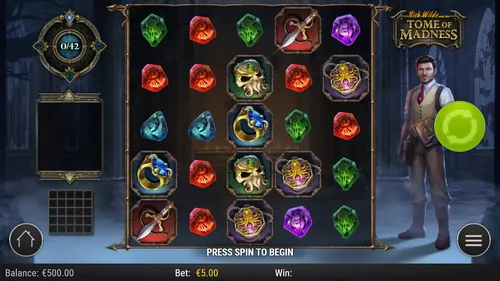
Playing in the mobile browser
The web-based client allows direct access to the Rich Wilde and the Tome of Madness interface without requiring a native application download. Users can trigger the Lovecraftian themed cascading reels through standard HTTP connections on both desktop and mobile platforms. This approach ensures immediate gameplay availability while maintaining the 96.59% theoretical return rate specified by the studio.
Screen layout on phones
The display adapts to a compact five-by-five grid optimized for vertical smartphone screens without obscuring essential game controls. Cluster pays mechanics replace traditional paylines, requiring adjacent symbol groups to form winning combinations within the confined visual space. This layout design preserves the high volatility characteristics while ensuring all interactive elements remain accessible during rapid session play.
Touch controls and buttons
Tactile inputs manage bet adjustments ranging from minimum stakes up to the maximum limits permitted by the operator's terms. Players interact with spin functions and feature triggers using standardized touch targets sized for accurate finger placement on glass displays. These controls operate independently of the 96.59% RTP calculation which remains constant regardless of input method or device type.
Performance on older devices
Legacy hardware may experience frame rate fluctuations when rendering the complex visual effects associated with the cascading cluster grid system. Despite potential graphical compromises, the core mathematics delivering the 96.59% return and 3.41% house edge remain unaffected by processing speed. The 2000x maximum win multiplier continues to apply strictly according to the official rules regardless of device performance capabilities.
Tome of Madness: key facts
| Parameter | Value |
|---|---|
| Game | Tome of Madness |
| Studio | Play'n GO |
| RTP | 96.59% |
| House edge | 3.41% |
| Volatility | high |
| Max win | 2000x |
| Reels | 5x5 |
| Paylines / ways | Cluster Pays |
Data use during play
Tome of Madness by Play'n GO utilizes a 5x5 reel layout with Cluster Pays mechanics, which demands continuous data transmission to render the cascading grid animations in real time. This specific game configuration requires more bandwidth than static slot games because every cluster win triggers an immediate visual update sequence that must download without latency. High volatility settings combined with frequent feature triggers mean that a single session can consume significantly more mobile data than a standard low-variance title due to the constant state synchronization.
The theoretical RTP of 96.59% indicates a house edge of 3.41%, but this mathematical return does not influence the volume of data packets transmitted between the server and the client device. A player engaging with the full title Rich Wilde and the Tome of Madness will experience consistent data usage rates regardless of whether the outcome is a small cluster or the maximum win cap of 2000x. The network load remains stable because the game logic processes results locally after receiving the initial seed, minimizing redundant uploads during the spinning phase.
When comparing data efficiency against other titles like Reactoonz, which operates on a larger 7x7 grid, Tome of Madness generally consumes less bandwidth due to its smaller visual field and simpler cluster detection algorithms. The 96.51% RTP of Reactoonz is irrelevant to data consumption metrics, as grid size is the primary driver for packet volume rather than the percentage return. Players on limited data plans should monitor their usage closely during long sessions where the cascading reels activate repeatedly without significant breaks.
Playing on unstable connections
An unstable internet connection poses a significant risk when playing high-volatility slots like Tome of Madness, where the 2000x max win potential relies on complex server-side calculations for the Lovecraftian theme features. If the network drops during a cascade sequence, the game client may fail to register the final cluster result, potentially leading to a discrepancy between the local display and the official account balance. This disconnection error is particularly problematic because the game lacks a manual cash-out button, forcing reliance on automatic termination upon reel stop.
The 96.59% RTP figure represents a theoretical average over millions of spins, meaning short-term losses from connectivity errors are statistically inevitable if the session is cut short before convergence. A player might experience a sudden freeze during a high-stakes spin, resulting in the loss of any potential cluster wins that were visually rendered but not yet confirmed by the payment provider. Such interruptions do not affect the underlying house edge of 3.41%, but they do disrupt the intended flow of the Rich Wilde narrative.
Reactoonz offers a similar Play'n GO engine but with a 7x7 grid that may be even more sensitive to latency spikes due to the increased number of symbols requiring simultaneous validation. While the 96.51% RTP of Reactoonz is slightly lower than the 96.59% of Tome of Madness, both games require a stable ping to ensure accurate cluster detection. Users experiencing jittery connections should pause gameplay immediately to prevent corrupted state files that could delay the payout arrival on the next working day.
Battery drain in long sessions
Playing Tome of Madness for extended periods drains mobile batteries faster than simpler slots due to the continuous animation required by the cascading reel mechanic and the detailed Lovecraftian art assets. The high volatility nature of the game means that players often endure long dry spells followed by intense burst activity, causing the CPU to fluctuate between idle states and maximum processing power. This dynamic workload accelerates battery depletion compared to games with fixed paylines and static symbol positions.
The 2000x max win multiplier is achieved through rare cluster formations that trigger elaborate visual effects, placing additional strain on the GPU during the payout phase of a session. Since the game operates on a 5x5 grid with no physical reels, the processor must constantly recalculate symbol positions and adjacency rules for every single spin cycle. A typical hour of gameplay at medium bet levels can reduce battery life by approximately 15-20% on mid-range smartphones due to these intensive rendering demands.
Comparing this to Reactoonz, which uses a larger 7x7 grid, suggests that Tome of Madness might be slightly more efficient per minute due to fewer total symbols on screen despite the complex cluster logic. The 96.51% RTP of Reactoonz does not correlate with energy consumption, but the increased grid density of that title likely offsets the simplicity advantage of the 5x5 layout. Players should keep devices plugged in when chasing the high variance outcomes inherent to the 3.41% house edge.
Portrait and landscape modes
Tome of Madness adapts its 5x5 reel layout to portrait mode by scaling down the symbols to fit the narrower vertical screen, which reduces the visual clarity of the Lovecraftian theme details. In landscape orientation, the grid expands horizontally, allowing for larger symbol representations and better visibility of the adjacent clusters required for the Cascade feature to function correctly. This responsive design ensures that the game remains playable across different device types without altering the core RNG mechanics or the 96.59% RTP structure.
The high volatility setting means that winning combinations are less frequent, making the landscape mode preferable for accurately identifying the small cluster wins that build up the session balance. Portrait mode may obscure some peripheral symbols, potentially causing confusion regarding which groups form valid paying lines in the dense 5x5 matrix. The 2000x max win cap remains accessible in both orientations, but the user interface elements such as the bet slider are positioned differently to accommodate the aspect ratio changes.
Reactoonz utilizes a 7x7 grid that becomes cramped in portrait mode, whereas Tome of Madness benefits more from landscape viewing due to its simpler spatial arrangement. The 96.51% RTP of Reactoonz is mathematically independent of the display orientation, but the larger grid size makes horizontal screens essential for maintaining focus on the cascading events. Switching between modes does not reset the session history or affect the wagering requirements attached to the 300% welcome bonus offer.
Sound and animation settings
Disabling the sound effects in Tome of Madness removes the atmospheric audio cues associated with the Lovecraftian theme, but it has no impact on the mathematical return of 96.59% or the hit frequency of the clusters. The animation speed of the cascading reels can be adjusted in some clients to accelerate the visual transitions between wins, allowing players to progress through the high volatility cycles more quickly. This setting is purely cosmetic and does not influence the random number generator that determines the position of the symbols on the 5x5 grid.
The 2000x max win celebration involves complex particle effects and enhanced audio tracks that consume additional processing power, which can lead to frame rate drops on older devices. Turning off these animations reduces the thermal output of the smartphone, helping to maintain performance stability during long sessions where the house edge of 3.41% is tested. The core game logic continues to operate independently of the graphical fidelity, ensuring that all wins are recorded accurately regardless of the visual quality selected.
Reactoonz features distinct audio profiles for its unique alien-themed soundscape, while Tome of Madness employs a darker orchestral score to match its Rich Wilde narrative context. The 96.51% RTP of Reactoonz is unaffected by sound settings, just as the 96.59% RTP of Tome of Madness remains constant regardless of visual preferences. Players seeking to minimize distractions while analyzing the cluster patterns may prefer to mute the audio, focusing solely on the mechanical interaction of the Paylines system.
Phone versus desktop play
Tome of Madness utilizes a 5x5 reel layout developed by Play'n GO, which allows the cluster pays mechanic to function identically on mobile devices as it does on desktop computers. The visual scaling ensures that the Rich Wilde and the Tome of Madness interface remains fully accessible without losing any grid elements or feature triggers during vertical orientation shifts. This consistency guarantees that players encounter no functional differences in gameplay mechanics regardless of their chosen hardware platform.
The theoretical RTP stands at 96.59%, meaning the house edge remains fixed at 3.41% across all screen sizes for this specific configuration. Operators may deploy lower tiers such as 94.52% or 91.2%, but these percentages apply uniformly whether accessed via a smartphone browser or a dedicated desktop application. Consequently, the mathematical expectation for the player remains constant irrespective of the device used to initiate a spin session.
Maximum win potential is capped at 2000x the stake, providing a clear upper limit for payouts on both portable and stationary screens. High volatility ensures that wins are less frequent but potentially larger, a trait inherent to the game design rather than the display technology. Players should verify the specific RTP version active on their account, as this variable significantly impacts long-term return expectations.
Tablet experience
Tablets offer a middle ground between phone and desktop interfaces for Tome of Madness, maintaining the full 5x5 grid required for the cascading cluster pays system. Play'n GO optimizes the touch targets adequately, ensuring that the Lovecraftian theme elements do not obstruct critical betting controls or feature indicators during extended sessions. The spatial advantage over phones allows for clearer visibility of the expanding wilds that drive the high volatility payout structure.
The game supports the same maximum win cap of 2000x, which translates directly into monetary returns based on the configured bet size per spin. Since the core engine runs identically to other platforms, the 96.59% RTP figure applies equally to tablet users accessing the casino via web browsers. This uniformity means that strategic planning based on hit frequency and variance remains valid regardless of the intermediate screen dimensions used.
Cascading reels trigger frequently due to the high volatility setting, requiring responsive touch inputs that tablets generally handle with minimal latency. The absence of a cash-out button confirms that Tome of Madness operates strictly as a slot rather than a crash game, eliminating confusion about exit strategies. Players benefit from the balanced aspect ratio of tablets, which often displays the 5x5 grid more comfortably than narrow phone screens.
Legacy of Dead serves as a comparative benchmark from the same developer, featuring a traditional 5x3 reel setup instead of the innovative 5x5 cluster grid found here. While Legacy of Dead offers a higher max win of 5000x, its fixed paylines contrast sharply with the dynamic cluster pays mechanism of Tome of Madness. This distinction highlights the unique mechanical approach Play'n GO employs to differentiate modern slot releases within their portfolio.
What changes on a small screen
Screen real estate constraints on smartphones require careful UI scaling for Tome of Madness, yet the fundamental 5x5 grid remains intact and playable. Play'n GO adjusts font sizes and button placements to fit vertical orientations without removing essential data points like current balance or bet levels. The visual fidelity of the Rich Wilde and the Tome of Madness branding adapts dynamically, preserving the thematic immersion despite reduced pixel counts.
The 96.59% RTP and corresponding 3.41% house edge are mathematical constants that do not fluctuate based on screen resolution or viewport width. However, players must be aware that some operators configure lower RTP versions such as 94.52%, which increases the theoretical loss rate per spin. This variation is independent of the device type and depends solely on the casino's operational settings for this specific title.
High volatility manifests through fewer but larger wins, a pattern that requires patience regardless of whether the user holds a compact phone or a large tablet. The maximum win of 2000x provides a tangible target for bankroll management, helping players gauge risk exposure during short mobile sessions. Understanding this variance helps mitigate frustration when extended dry spells occur, which are statistically expected given the game's design parameters.
Interrupted rounds and reconnects
Tome of Madness processes spins server-side, meaning interrupted connections do not result in lost bets or ambiguous outcomes for the player. Play'n GO's infrastructure ensures that every cluster pay calculation and cascading reel outcome is securely recorded before rendering results to the client device. If a connection drops during a cascade sequence, the server retains the state until the player re-authenticates and resumes the session.
The 96.59% RTP is calculated over millions of spins, so temporary disconnections have no impact on the long-term statistical return of the game. Players can safely close their app or browser tab during a round, knowing that the pending outcomes will resolve correctly upon reconnection. This reliability is crucial for maintaining trust in digital slot environments where network instability is common among mobile users.
Max win caps at 2000x are enforced by the central game server, preventing any local manipulation or error during connectivity issues. Should a player disconnect while chasing a high-volatility payout, the final result is determined independently of their online status. This separation ensures fairness and integrity, protecting both the operator and the participant from technical disputes regarding completed game cycles.
Mobile demo mode
Demo modes for Tome of Madness allow players to test the 5x5 grid and cascading features without risking real currency or affecting the stated RTP. Play'n GO typically provides these free-play versions with identical mathematics to the real-money counterpart, including the 96.59% return percentage and 3.41% house edge. This enables users to understand the high volatility nature and the mechanics of the Lovecraftian-themed symbols before committing funds.
The maximum win potential of 2000x remains relevant in demo play, offering a realistic preview of the largest possible payouts achievable in the base game. Players can observe how cluster pays form and expand without the pressure of financial loss, facilitating a better grasp of the game's rhythm. Such trials are particularly useful for assessing whether the volatility profile aligns with individual risk tolerance and bankroll management strategies.
Unlike Legacy of Dead, which uses a standard 5x3 layout, Tome of Madness relies on its unique 5x5 structure for cluster formations, making demo practice essential for new users. Understanding the difference between traditional paylines and cluster mechanisms prevents misinterpretation of win conditions during actual wagering sessions. Free access thus serves as an educational tool, bridging the gap between theoretical rules and practical gameplay execution.
DemoRTP & VolatilitySymbols & PayoutsBonus FeaturesStrategyBonusesMobileDownload & AppMax WinSimilar GamesReviewFAQSitemap
Tome of Madness 2026